


Corporate Website: What Is It and What Are the Best Practices?
Summary (TL;DR)
A corporate website is a company's official online showcase, used to present its services, values and contact details in a professional manner. It takes 9 essential steps to build an efficient corporate website, with everything it needs to make a good impression, generate trust and attract customers.
The 9 steps are: Home page, Site navigation, Fonts and readability, CTA buttons, About Us page, Success stories, Show customer feedback, Define a marketing plan, Create a corporate blog and invest in content.
Check out each of these steps in full throughout our post!

One institutional website is a company's official online presence. It acts as a digital business card, where visitors can find essential information about the business, such as its history, services, contact details and values. It serves to strengthen brand authority, attract customers and facilitate communication with different audiences, including partners and investors.
If you want to understand how an institutional website can generate concrete results, increase your credibility and open doors to new business, read on.
What is an institutional website and what is it for?
An institutional website is a digital communication channel that presents the company, The brand's name, proposal, products or services, and values. It helps position the brand in the market, conveying professionalism, security and clarity about what the business offers.
What is an institutional website for?
- Disseminate information about the company;
- Strengthen the brand image;
- Attract new customers and generate opportunities;
- Facilitate contact with different audiences;
- Support marketing actions and commercial strategies.
In short, the institutional website is no longer just a shop window, but a strategic starting point. It underpins digital marketing campaigns, improves online presence and helps to gain authority in the sector.
Why have an institutional website?
Having an institutional website is more than just a digital presence, it's a market requirement. It conveys credibility, improves communication with the public and acts as a foundation for marketing and SEO strategies. See the main advantages:
- Credibility and online reputation;
- 24/7 visibility and availability;
- Low cost and long-lasting return;
- Authority in your segment;
- Local and international reach;
- Sales potential and lead generation;
- Fidelização e relationship com o cliente;
- You can apply SEO strategies for organic positioning.
How to create a good corporate website?
Creating an efficient corporate website requires attention to at least 9 fundamental stages, from the structure of the home page to the definition of elements that reinforce the brand's identity. Each part of the site needs to be geared towards generating trust, facilitating navigation and clearly communicating the values of the business. Let's go?
1 - Home page
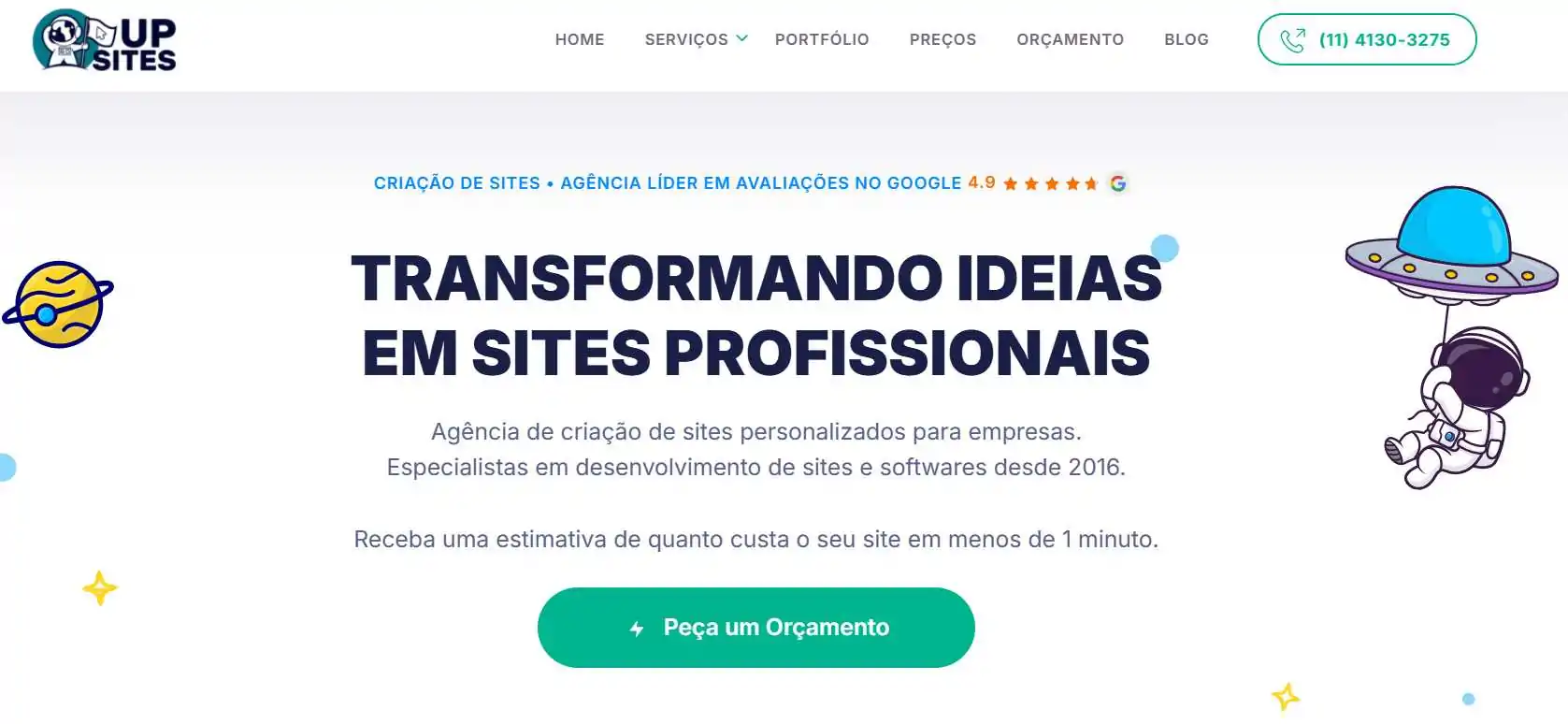
The homepage should be up in a few seconds, convey who the company is, o que ela faz e por que o visitante deveria continuar no site. Esse é o ponto mais importante da user experience, pois a maioria das pessoas decide se permanece ou não em até 10 segundos. Por isso, o carregamento rápido, o design limpo e a clareza de conteúdo são indispensáveis.
Take a look at our homepage:
What needs to be on the home page?
- Clear value proposition: state objectively what the company offers and to whom;
- Basic institutional information: mission, vision, values and competitive differentials;
- Visible contact: insira telefone, e-mail e, se possível, um botão de WhatsApp ou online chat;
- Links to social networks: show that the brand is active and accessible;
- Optimized images aligned with the service/product: choose real images that help to put things into context;
- Clear navigation menu: make it easier to get to other important pages, site navigability is very important;
- Logo and visual identityUse brand elements to reinforce authority and professionalism.
The home page doesn't need to be long, but it does need to be strategic. Use objective texts, organize the information blocks well and prioritize the visual hierarchy (what appears first on the screen should be the most important for the user).
2 - Site navigation
Navigation needs to be simple, intuitive and fast. Confusing menus, poorly organized pages and too many clicks put visitors off. For this reason, the corporate website must have a clear structure, with objective paths so that anyone can find what they are looking for effortlessly.
Check out how easy our menu makes navigation:

In addition to the easy structure, a responsiveness is mandatory: your website must work perfectly on computers, tablets and cell phones. This guarantees a good user experience, since the majority of hits come from mobile devices. In other words, if your site doesn't adapt to mobile, you're missing out on visits and opportunities.
3 - Fonts and readability
Para garantir a readability, use fontes de tamanho adequado, com bom contraste e espaçamento entre os textos. Um site bonito, mas com letras pequenas, cores ruins ou blocos longos demais, perde engajamento. A estética precisa andar junto com o reading comfort.
According to the PM3 platform, 94% of users abandon a website because they don't trust its design - which points directly to visual usability problems. In other words, taking care of the typography and making it pleasant to read can have a direct impact on the user's trust in the brand.
Ideally, you should keep blocks of text with lines between 45 and 60 characters and avoid dark backgrounds with white text. This tires the eye and makes it difficult to read for long periods of time. Think like a reader: if it's tiring, they'll leave the page. A readability is one of the silent pillars of an efficient website.
4 - CTA buttons
Call-to-action buttons (CTAs) are essential for generating conversions on your site. They need to be clear, objective and visible on every page, especially in the header and footer. A good CTA turns visitors into contacts, quotes, leads or sales.
This is an example of a CTA we use:
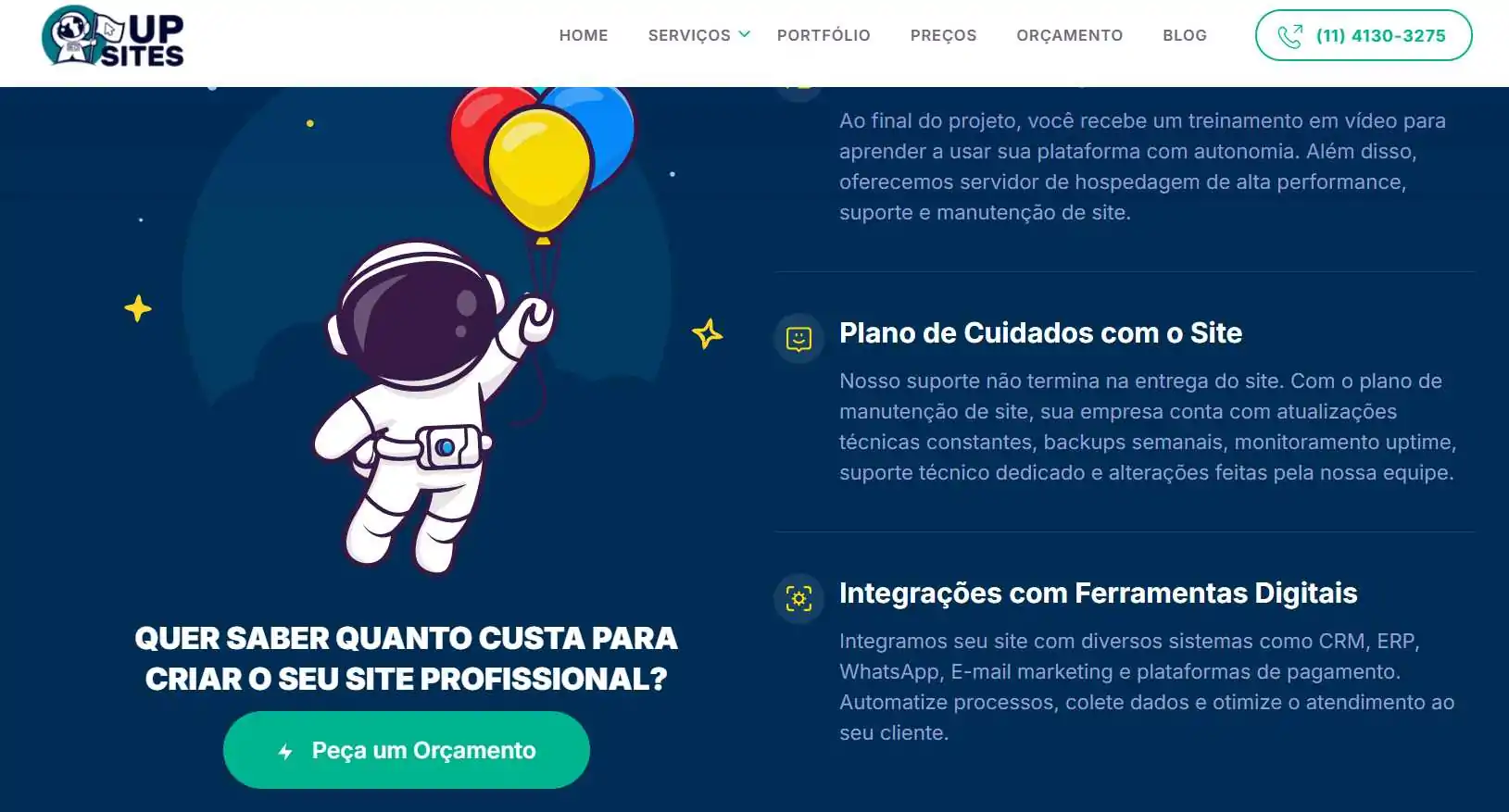
Use action verbs like “Request a quote”, “Talk to our team” or “See plans”. The strategic position and visual highlighting, such as a different color or a button with a border and shadow, help the user know what to do next. A website without a CTA is like a store without a help desk: people come in but don't know where to ask for help.
5 - “About Us” page”
A About Us“ page” is where the company shows who is behind the brand and what it really believes in. More than just telling the company's story, it needs to create connection, trust and transmit values that guide the business.
It can also function as a sales page: this is where you introduce yourself, tell how you came up with the business idea and what makes your company unique in the market. The aim is to highlight your differentials, generate identification and leave a good impression on those who come to you.
What this page should contain:
- A brief history of the business: how it came about and why it was created;
- The company's mission, values and vision;
- What the company does and for whom;
- A summary of relevant achievements or results (in figures);
- The presentation of the team or founders, with photo and position;
- Behind-the-scenes footage (if it makes sense for your segment);
- A light tone of voice, human and close to the reader.
Check out some tips on narrative structure for this page:
- Frame the scene: How did it all start? In what context did the company emerge?
- Report a problem: What motivated you to found the company? What pain did you identify?
- Accept the challenge: Show how you tried to solve this problem.
- Get to the solution: Explain how your company has evolved and what you offer today.
- Imagine the prospects: Point to the future. What do you still want to achieve?
- Include concrete data: Time on the market, number of clients, deliveries made, etc.
- Present real faces: Photos of the team, leaders or founders increase empathy.
Humanizing the business is one of the central roles of this page. When visitors see that there are real people behind the brand, they tend to trust it more and feel welcomed. Use good photos, objective texts and a coherent narrative. The first impression is also built here.
6 - Success stories
The success stories show in practice how your company has already helped other clients solve real problems. It is one of the most powerful ways of generating trust and attracting new business.
Each case should tell a clear story: what the customer's problem was, how your company acted and what the result was. Using simple language and concrete data (such as increased sales or reduced costs) makes the content more credible.
- Good practices for a successful case:
- Introduce the client (name and sector);
- Explain the challenge you faced;
- Show what was done (solution applied);
- Present the results with data;
- Insert excerpts from customer testimonials or quotes;
- Use images, graphics or videos (where possible).
This type of content helps the visitor to imagine themselves having the same results, and increases their chances of closing a deal.
7 - Show customer feedback
Testimonials are key to conveying credibility. They act as social proof: they show that other people have already trusted your company and had good experiences.
Even though it's simple to set up, a testimonial page is often overlooked. But it can make the difference between a visitor leaving your site and another deciding to contact you.
Check out these tips for more effective testimonials:
- Ask customers to tell real stories, with problems and solutions;
- Use natural language, as if it were a conversation;
- Include the client's name, photo and, if possible, job title or company;
- Use screenshots from social networks, such as reviews on Google or Facebook.
Look at this carousel we used, it's a good idea for your site:
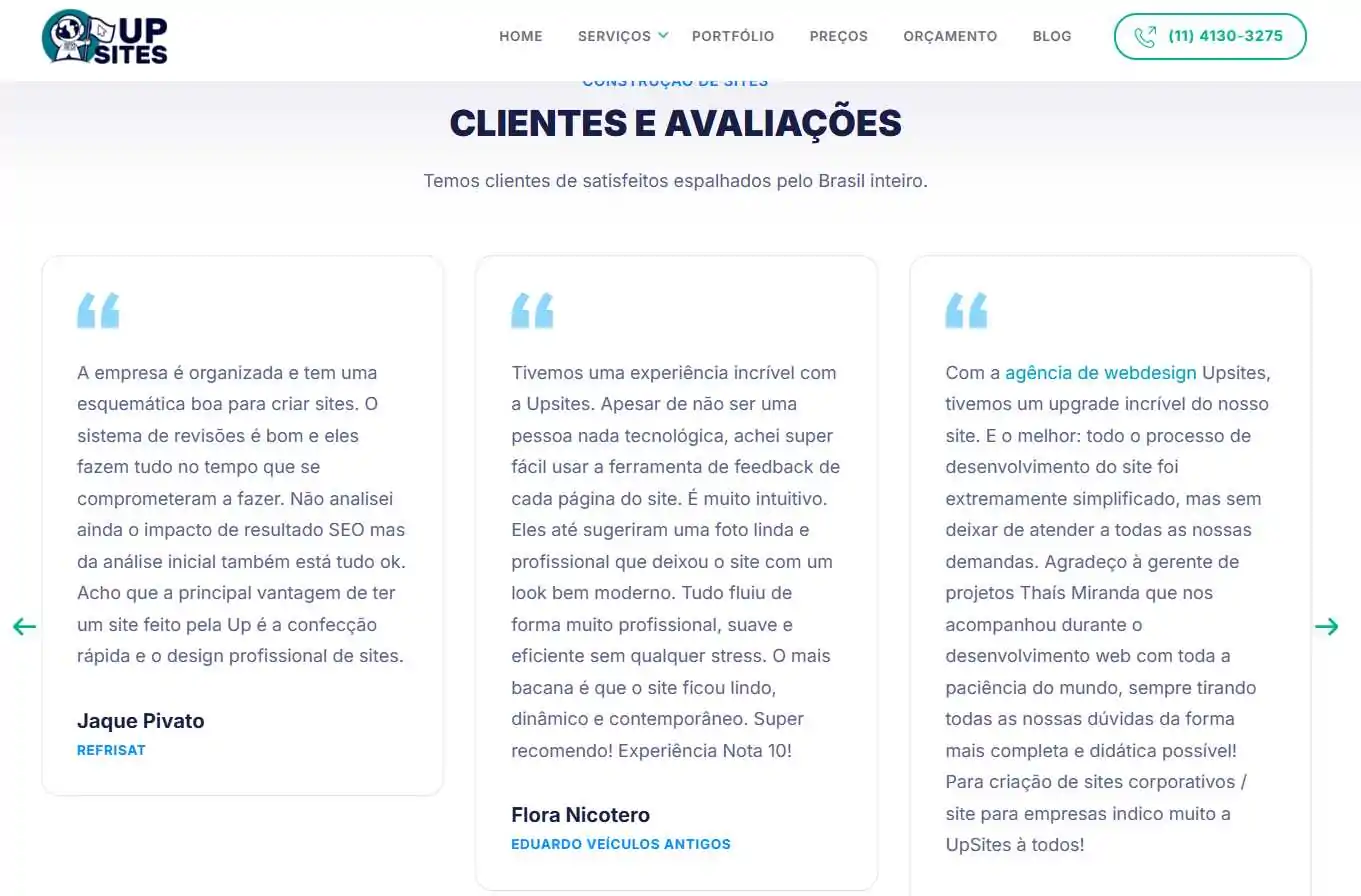
The ideal number varies, but the more the better, as long as they are genuine and relevant. Start with 5 to 10 testimonials and update as you receive more positive feedback. This shows that your company continues to generate good results.
8 - Define a marketing plan
A good corporate website needs a digital marketing plan to attract qualified visitors and generate concrete results. Without a strategy, it's easy to waste time and money on disconnected and ineffective actions.
The marketing plan defines which channels to use, such as SEO, social media, paid ads, email marketing and others. It must be aligned with the company's main objective, be it increasing sales, generating leads, launching a product or reinforcing the brand.
Here are some common objectives of a marketing plan:
- Fortalecer o reconhecimento da marca (branding);
- Promoting newly launched products or services;
- Attract visitors through strategic content;
- Increase conversions in seasonal or promotional campaigns;
- Generate relationships with the customer base.
A well-defined strategy allows you to use marketing as an extension of your website, acting as a constant growth engine.
9 - Create a corporate blog and invest in content
Having a corporate blog within your site is one of the most effective ways to attract organic visitors and show authority in your sector. Google prioritizes updated websites with relevant content, and a blog is the best tool for this.
As well as improving your ranking, blogging brings your brand closer to your audience. With articles that answer questions, teach something useful or present solutions, you gain trust and generate value even before the first commercial contact.
Quality content turns your website into an information channel, attracts followers and makes potential customers recognize your company as an expert in the field. Over time, this is reflected in more visits, more opportunities and more sales.
How much does an institutional website cost?
One institutional website usually costs between R$ 1,000 and R$ 15,000, depending on the number of pages and functionalities required, such as contact forms or content management, as well as design and optimization adjustments.
Sites mais simples, com poucas páginas, ficam na faixa de R$1.000 a R$5.000; já projetos para small businesses com recursos extras chegam a R$5.000 a R$15.000.
If you would like a personalized assessment or to know how much your specific corporate website project might cost, our team is ready to help you with a quick and transparent quote.
Creating a professional institutional website is more than having a digital presence, it's about building authority, winning clients and standing out in the market. If you want a strategic, beautiful website designed to generate real results, you can count on UpSites. Request a quote now and find out how we can turn your website into a powerful business tool.

Frequently Asked Questions
What is an institutional website?
An institutional website is the place where a company presents its information, products and services, acting as a digital business card. It is essential for providing credibility and transparency, as well as being the gateway for potential clients, partners and investors to get to know the brand.
What are the benefits of having an institutional website?
The main benefits include increased credibility, greater visibility in the market, the possibility of reaching local and international audiences, and the creation of a platform that strengthens the relationship with the consumer and potential clients.
What elements should an institutional website have?
An effective corporate website should have an attractive homepage, clear contact information, links to social media profiles, a simple and intuitive navigation menu, well-placed CTA buttons, an “About Us” page that tells the story of the company, customer testimonials and success stories.
What's the difference between an institutional website and an e-commerce site?
While institutional website is focused on presenting the company and building its image, the e-commerce is a virtual store whose main purpose is to sell products or services online. Both have different purposes, but can coexist depending on the business strategy.

Caio Nogueira
Caio Nogueira is co-founder of UpSites and a reference in website development and SEO consultancy. With over 10 years' experience and more than 900 projects completed for brands such as KaBuM, UNIMED, USP and Nestlé, Caio stands out for his competence in digital project management. Caio has also been a guest author on influential digital marketing websites such as Neil Patel, Rock Content, Hostinger, Duda, Hostgator and Locaweb, where he has shared his expertise in SEO and content marketing.
See all posts


 Calculate Price Now